

Most Americans think the Author is Dead

When asked whether the meaning of a work of art should be based on the intent of the author, the reception of the audience, or objective facts about the artwork, 46.8% said that the audience's reception of the piece gave it meaning. 24.4% said that some objective facts about the artwork gave it meaning independent of the author or audience, and only 28.7% said that the author's intent gave the piece of art meaning.

While this could be distinguished from views of the impact of the author in other realms outside of aesthetics, it does give a clear picture of strong postmodernist sentiment amongst the American populace. This is supported by responses to another question on the purpose of art. Instead of embracing any specific metanarrative of the goal for art, a majority of Americans accepted aesthetic pluralism (art does not need to have any one purpose, 60.0%), rejecting aestheticism (art for art's sake. 10.3%), aesthetic functionalism (art for a purpose such as education, persuasion, or emotional relief, 20.3%), and aesthetic realism (art should serve as a mirror to the world 9.4%).

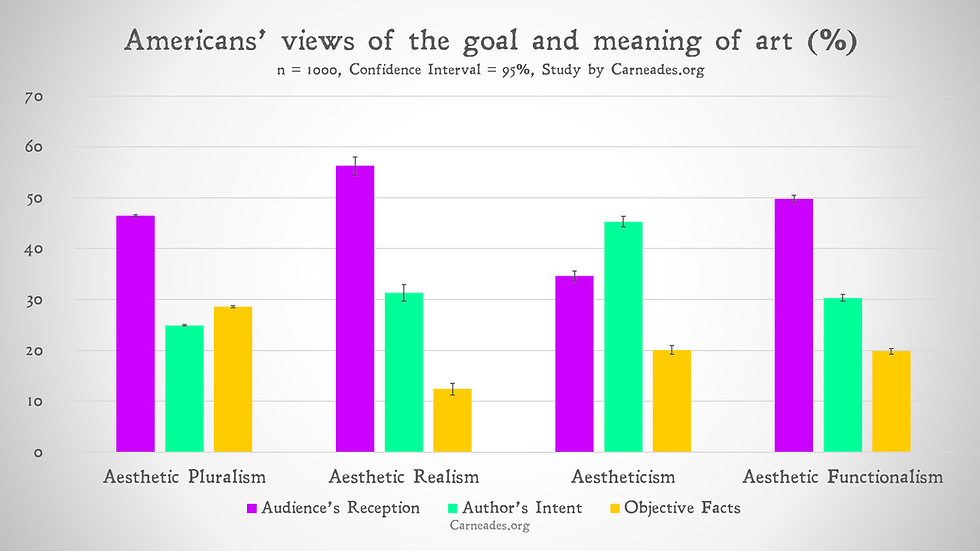
And there is evidence that the views on these questions are linked. Believing in Aestheticism, makes one 18%*** more likely to view the Author's Intent as the true meaning of a piece of art. Counterintuitively, believing in Aesthetic realism makes one 13%*** less likely to believe that objective facts are what give art meaning. The graph below shows the how the people who believe in each goal of art are divided between those who believe in each meaning of art (e.g. 45% of Aestheticists think art means what the author says it means).
Philosophical Background
The death of the author is the idea that there is not one definitive meaning of a given text based on what is in the head of the author, but rather that there can be many different meanings of a text based on individual audience experiences of reading it. For a basic introduction to the idea of the death of the author, you can check out this short video on the fallacy of intentionality.
These ideas are closely related to postmodernism. Postmodernism is a complicated topic in philosophy, which spans a range of disciplines and describes different movements in art, philosophy, politics, and science. At its core it represents a rejection of metanarratives, which leads to multiple viable interpretations of information, whether those are data points or a piece of art. For a full explanation of the topic, check out our series "This is not a series on Postmodernism."
Finally, for a primer on the debate surrounding the purpose of art, whether we should embrace art for art's sake, or art should have some purpose, check out this series on Oscar Wilde's The Decay of Lying, where we look at Wilde's case for aestheticism and how that contrasts with aesthetic functionalism and aesthetic realism.
Younger Americans more likely to be Functionalists and believe the Author is Alive
Age stands out as one of the top demographic attributes associated with beliefs about aesthetics. Younger Americans are less likely to be Aesthetic Pluralists and more likely to be aesthetic functionalists. Using a linear probability model, being under 45 is associated with being 24.8%*** less likely to be an aesthetic pluralist, and being 14.8%*** more likely to be an aesthetic functionalist. Less than half of Millennial and Gen Z Americans are aesthetic pluralists. Younger Americans are also 10.8%*** less likely to think that the author is dead. Millennials especially fall into this category, who are 6.9%** less likely to think the meaning of art is determined by objective facts and 6.8%* less likely to think the meaning of art is determined by the audience's reaction.

Race, Party, and Philosophy Background Associated with Views on the Death of the Author
Other demographic characteristics are not especially significantly correlated with views on the death of the author, however two stand out as having some connection. The first is whether or not someone has a background in philosophy. Having a Philosophy degree makes someone 14%*** more likely to think that the author is alive, and that their views are what determine the meaning of a piece of art, it also makes one 9%** less likely to think that objective reality determines the meaning of art. Conversely, never having taken a philosophy class increase the chances you think that the meaning of a piece of art can be determined by objective facts by 6%**.
Race and Political party also seem to have some association, as being non-white increases your chances of thinking that the author's interpretation gives art meaning by 9%***, and drops the changes you think the audience gives art meaning by 8%**. Being a democrat increases your chances of thinking the author gives art meaning by 8%**.

In terms of views on the purpose of art, we see a clear separation by income, with individuals over the 60th percentile in income being 7%*** more likely to think art should be made only for art's sake, and 5%* less likely to be an aesthetic functionalist. Household income overall is predictive of aestheticism, an increase in $1,000 in annual income increases the likelihood of being an aestheticist by 2.8%** and increases the likelihood of being an aesthetic pluralist by 5.6%**. Low income individuals are 14.3%*** more likely to be an aesthetic functionalist. One might guess that upper income individuals are less concerned with the functions of art, while lower income individuals might want to get something beyond beauty out of a piece of art.

Views on Ethics Linked to the Meaning of Art
When looking for predictors of belief that the author defines the meaning of art, views on ethics seem to be quite significant. Using a dominance analysis, the likelihood of belief in the author's intent increases with belief in virtue ethics (by 18.8%***) and decrease with a belief in agent centered deontology (by 7.8%**). Divine command theory decreases the chances of belief in the audience determining the meaning of art (by 16.5%**), and increases the chances of belief in objective facts determining the meaning of art (by 21.2%***).

There are also some interesting interactions between views on the purpose of art and views in political philosophy. Belief in communitarian nationalism (the claim that countries should be bound by a common culture and heritage), increases the chances of believing in Aestheticism by 12.1%*** and the chances of believing in Aesthetic Functionalism by 10.5%***.

There are a range of other positions that correlate with these ideas. The graphics below show the percentage impact of two of the positions based on a dominance analysis. Here are just a few of them. Belief in the consciousness of artificial intelligence seems to be predictive of both believing the author is still alive (the binary (agree/not) increases chances by 10%**) and predictive of believing in aesthetic realism, agreeing that AI has consciousness increase the chances of being an aesthetic realist by 20%***.
There are also some interesting interactions between beliefs about ethics and epistemology with both of these views. One predictor of aesthetic realism is the claim that atheists cannot be moral: disagreeing with the claim that atheist can be moral increases you chances of being an aesthetic realist by 14%***. On the other hand, not believing in an afterlife, makes you 7%** less likely to think that the author's intent is the meaning of art.
Despite these differences on ethics, both views are predicted by the belief that you could be dreaming right now (11% increased chances for the author, 9% increase for aesthetic realism), but also by the claim that experts can provide knowledge (10%*** increased chances for author's intent, 11%*** for aesthetic realism). Indicating that these groups may be more likely to trust experts than their senses (which might align with both the idea of trusting an artist to know the meaning of their work, and desiring art that is a literal representation of the world.

Methodology Specifics
Before leaving, here are the specifics of how the question we have been focusing on was asked. This study was conducted in March of 2026 on a representative sample of Americans. For more on the overall methodology of this survey consult this blog post. As we publish more blogs on this survey the information on the questions for the other philosophical positions will come out. The best attempt was made to make the statements succinctly represent the three positions, while still being accessible to a general audience without too much philosophical lingo.
The following phrasing was used to judge views on the meaning of art:
Which of the following most closely represents your view on what gives art a particular meaning?
The intent of the author (if the author says a piece of art means X, then it does).
The reaction of an audience (if an audience interprets a piece of art in a certain way then that is its meaning).
Objective facts about the art separate from the audience’s reaction or the author’s intent.
The following question was used to judge views on the purpose of art, where 1 corresponds to aestheticism, 2 to aesthetic realism, 3 to aesthetic functionalism, and 4 to aesthetic pluralism.
What best describes your view of the goal of art?
Art should only be for art's sake, not to imitate reality or serve a purpose.
Art should imitate reality, serve as a mirror to society.
Art should serve some purpose, such as education, persuasion, or emotional relief.
Art does not need a single purpose, different pieces of art can have different purposes.
Data like these are a public good that can help us all understand how normal people view important philosophical questions. Our goal is to put out more surveys like this in the future, but we need your help! Have you ever wanted to ask a philosophical question to a representative sample of Americans? Have you ever been curious about how normal people see questions that are important to philosophers? You now have the chance to get your question on our next nationally representative survey! We need around $2,500 to conduct another survey, hopefully in the next few months. Visit our Patreon page to find out more. Here's how you can help:
Raw Data $10: If you want access to the raw data from the survey we just finished, it is available! You can use it to run and publish whatever analyses you want, just 1) don't publish the raw data yourself and 2) make sure to give credit to Carneades.org. We'll even throw in the data from our pre-survey of 100 people.
Likert Statement $30: Want to see how much Americans agree or disagree with a certain statement? For just $30, you can add a statement to our Likert question, where participants will respond to it with Strongly Agree, Agree, Neither Agree or Disagree, Disagree, or Strongly Disagree. The statement must be about philosophy, less than 150 characters, and safe for work. We'll include the raw data from the next survey.
Multiple Choice Question $150: Want to design and ask your own multiple choice question? You can have up to 1000 characters in the question and up to 500 characters in each of the answers. Only up to 10 answers are allowed. The question must be about philosophy and safe for work. We'll include the raw data from the next survey. We will even throw in a Likert statement (as described above) and the raw data from the next survey for free!
We reserve the right to edit any statement for grammar, spelling, or to clarify any philosophical ideas for the respondents. We also reserve the right to reject any statements, but will give a full refund for any that are rejected.
Notes:
All graphs show the total sample cut first by the free will question first, then by the demographic group or other philosophical question. So, when a graph shows 31% for Low Income and Aesthetic Functionalism, it means that 70% of Low Income individuals are Aesthetic Functionalists, regardless of which value is used for grouping vs color. All margins of error are calculated at the 95% confidence level.
Dominance analysis is run with all of the views in the study converted to binary or Likert scales. All likelihood estimates are created using a linear probability model with both dependent and independent variable treated as binaries.
*Significant at the p < 0.1 level
**Significant at the p < 0.05 level
*** Significant at the p < 0.01 level
How to Cite this Report:
Carneades (2026). Most Americans think the Author is Dead. Experimental Philosophy. https://www.carneades.org/post/most-americans-think-the-author-is-dead


Comments